Project Information
Coral reefs provide multiple goods and services for people, including shoreline protection from erosion and storms, food, medicines, recreation, tourism, and cultural and spiritual connection. Reefs today face increasing stress from land-based pollution, ocean acidification, warming ocean temperatures, and increasingly extreme weather events. These combined pressures all significantly degrade coral resilience, leaving corals susceptible to bleaching events and subsequent death. Coral mortality exposes the reef to erosion, reducing habitat availability in the natural reef system and resulting in lower abundance and biodiversity of reef species. Coral decline also reduces coastal protection and can lead to the limitation of cultural practices such as fishing, loss of tourism-related income, and general negative impacts on recreational ocean use.
Based on Science
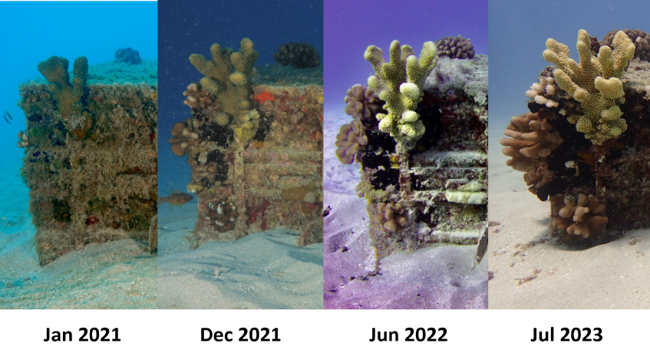
Coral growth on a CReME module over time (image credit: Hixon Lab, University of Hawaiʻi)
The foundation of REEFrame is based on the Coral Resilience Module Experiment (CReME) feasibility study conducted by Dr. Mark Hixon’s lab at the University of Hawaiʻi. In 2016, the CReME project began as an artificial reef pilot study with six units deployed at each of two sites: Hanauma Bay and Waikīkī. The cubic-meter (m3) concrete modules were deployed offshore of Waikīkī at depths ranging from 40 to 60 feet on sandy ocean floor, the same location as the site for REEFrame.
The CReME project tested whether concrete modules providing shelter holes would enhance the local abundance of herbivorous fishes and sea urchins that keep reef surfaces clean so corals can thrive. Corals naturally settled, survived, and grew on the modules. Additionally, corals of opportunity attached to the modules survived and grew, demonstrating the coral nursery capability of artificial structures that can withstand large ocean swells. Overall, the CReME project showed that scaling-up concrete structures to enhance Waikiki coral reefs is feasible. (Dilley et al., 2026)
Using Innovative Technology
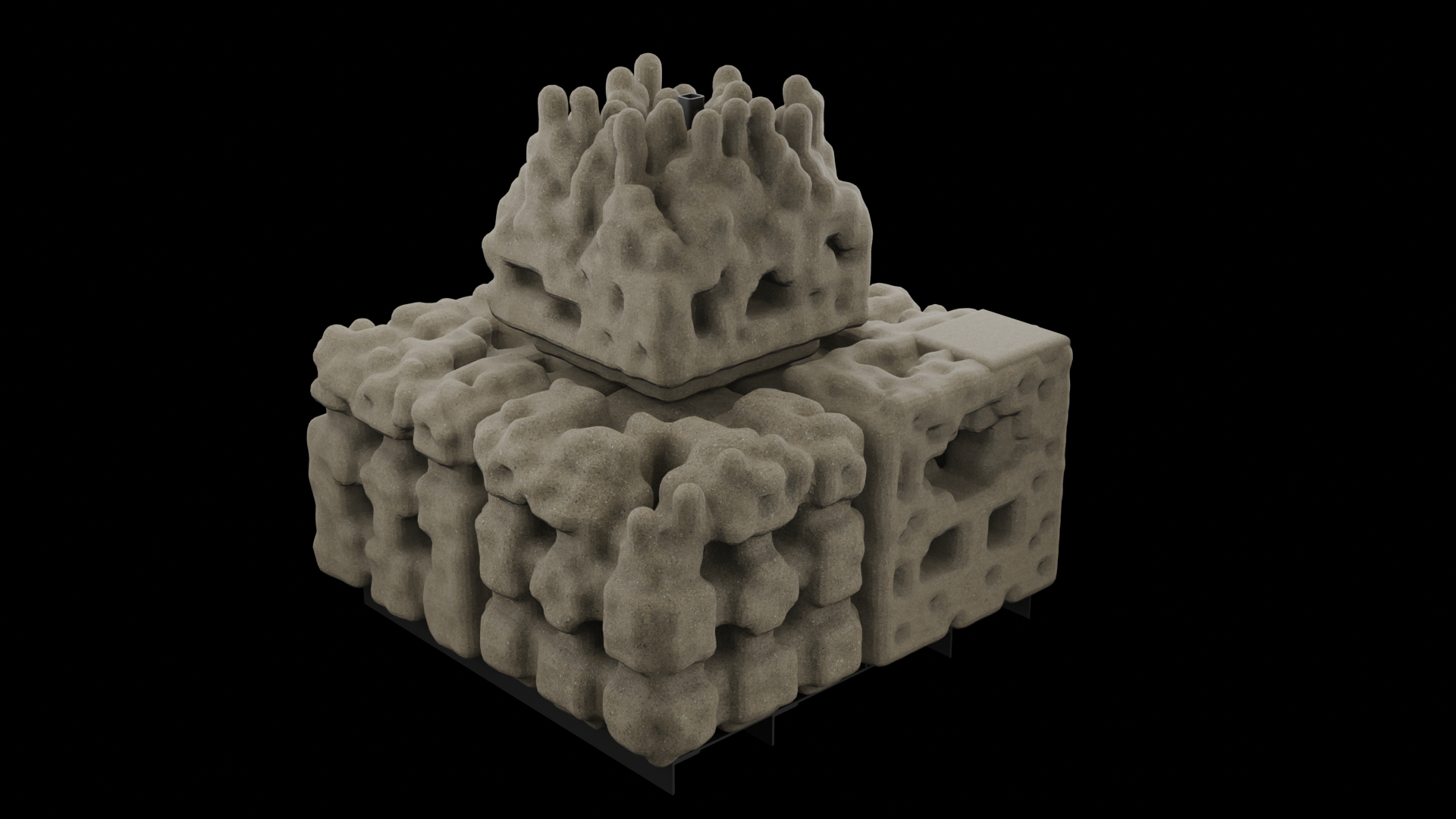
Render of one REEFrame module (image credit: Natrx)
The REEFrame modules are manufactured using Natrx’s DryFormingTM process, which enables the rough surface texture and creation of naturalistic features to foster coral growth. The modules have intentional variation with holes of varying sizes, crevices, ledges, and other design elements that mimic a natural reef structure. These features vary between modules to provide a complex habitat for coral, fish, and other marine organisms.
Each module will measure six feet wide by six feet tall, weighing an average of five tons. The modules are designed to withstand a 50-year southern swell storm event.
Preparation, Relationship Building & Outreach
Relationship building and outreach has been an essential element to the REEFrame project. To date, the project team has hosted over 40 meetings with community leaders and cultural groups, elected officials, Waikīkī residents and ocean users, and the visitor industry. Outreach and engagement will continue to be a priority, including ways to involve the community with the project in a more tangible way.
To learn more or get involved contact info@reeframehi.org.
Site Selection
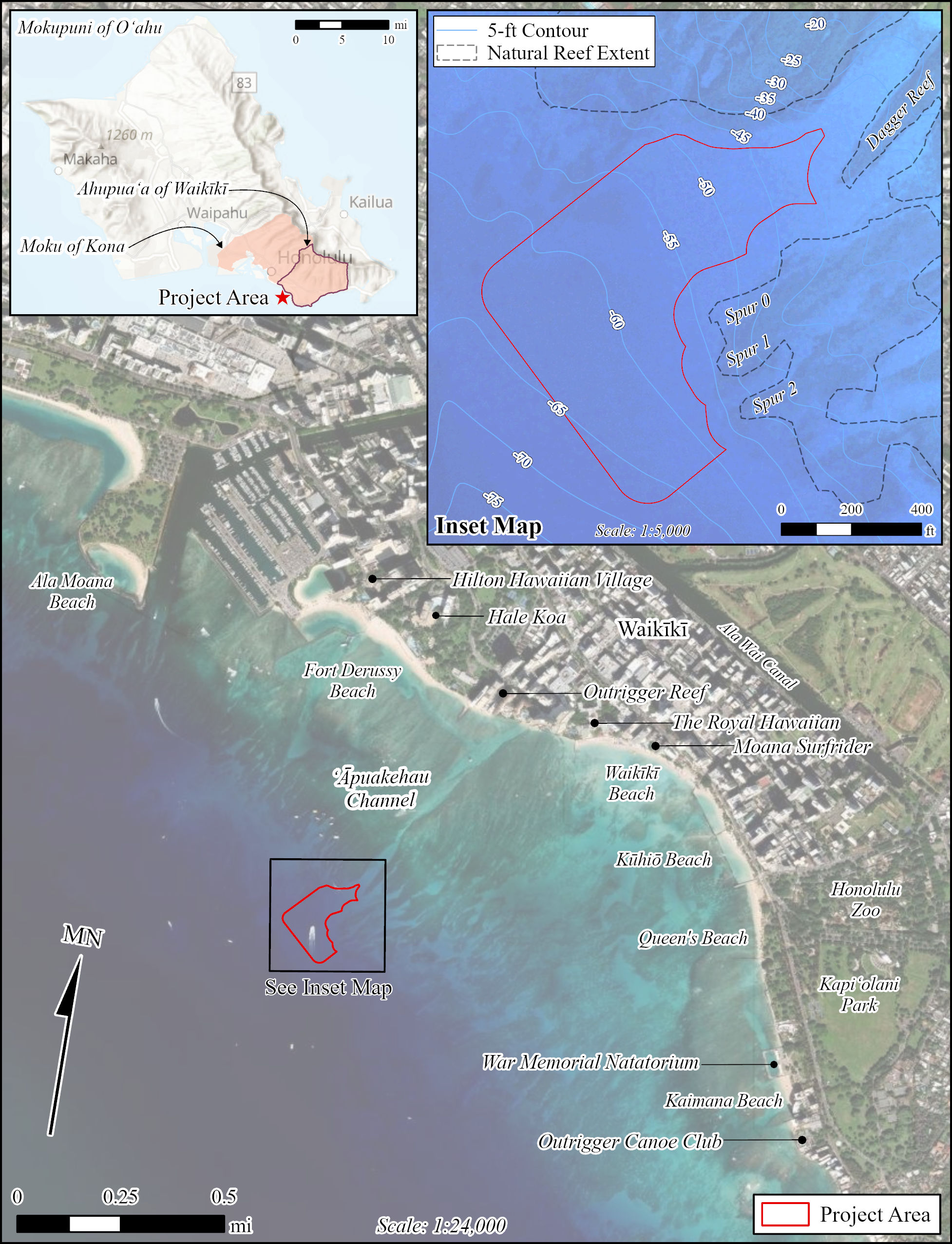
REEFrame Project Area (image credit: PCSI)
To select the best site for the REEFrame project in the Waikiki, the project team evaluated available geospatial data, selected eight potential sites for consideration, and physically inspected candidate sites. Sites were located in areas suitable for construction of the nursery and adjacent to natural reefs suitable for coral restoration activities.
Geospatial and field data were collected on potential impacts to navigation, seafloor characteristics and biological resources including coral cover, proximity to natural reef, suitability for construction, proximity to marine protected area(s), potential for user conflicts (traditional practices, surfing, diving, and fishing), and potential for impacts to cultural resources.
The selected REEFrame project site is located at the mouth of the ʻĀpuakēhau Channel (aka Halekulani Sand Channel) off Waikīkī Beach in Honolulu, on the island of Oʻahu, Hawaiʻi. The Project Area is 0.52 to 0.75 miles offshore in water depths between 40 and 60 feet. At these depths, REEFrame will avoid high wave energy, minimize effects on surf spots, and enable feasible underwater restoration activities by SCUBA divers, as previously demonstrated by the CReME project at the same site.
This site is located in the center of Waikīkī Bay near a natural spur and groove reef formation that will provide coral larvae and corals of opportunity to the REEFrame modules. The surrounding area is composed primarily of unconsolidated sand with very little biological cover, which will be suitable for construction with relatively low risk of harming corals or other marine life.
On the Horizon
Utilizing Best Management Practices (BMPs), the REEFrame modules will be deployed in accordance with state and federal permits. Conservation International will be securing the services of a construction company to deploy 150 REEFrame modules within a time window of January – March 2027 to avoid summer swells (pending permit approvals).
The team will conduct pre- and post-deployment monitoring surveys at the site, followed by restoration of corals of opportunity.
If you have any additional questions please contact our team at contact info@reeframehi.org.